 I feel very honoured to be able to bring the Hendrickson Method to the UK. Back in 2003/4 I had been searching for a technique that would allow me to treat musculoskeletal conditions that didn’t create a secondary inflammatory response; one in which the patient would have conscious awareness to the change taking place; and one that would increase my precision as a therapist.
I had built a practice on treating patients with long term chronic pain and layers of dysfunctional postural patterns. Using the Hendrickson Method enabled many of the treatments I provided to my clients to hold for longer periods, and patients made greater recovery. Tom Hendrickson, creator of the Hendrickson Method, works hard at developing his skills and knowledge and has passed on his expertise and wisdom to myself, enabling me to teach his work here in the UK.
The Programme
The programme is led by Sue Bennett, the UK’s first Certified Hendrickson Method Teacher, and is open to all remedial massage therapists, sports therapists, physiotherapists and others certified in movement therapies.
The Hendrickson Method training programme and certification is made up of a two-day introduction (18hrs) followed by four, four-day workshops (32hrs each), and concluding with a three-day workshop (22hrs) totalling 168hrs in training.
After completion of the two-day introduction, the programme is divided into four sections, detailed further below.
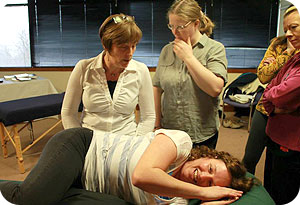
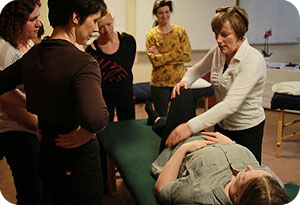
At the close of each four-day workshop there will be a 20 question quiz, requiring short answers. There will plenty of practice time, in pairs with another student, to ensure that there are no misunderstood strokes and provide an opportunity to ask any questions you may have.
Finally, at the three-day workshop, the practical assessment will take place. On these last three days we will explore assessment more deeply, create treatment plans, and focus on clinical application. We will spend time linking the strokes together as one would in clinical practice. You will have the opportunity to develop clear, sensitive, patient-empowering communication skills.
With all of the workshops, there will be support assistants at practice times.
Required reading for the course:
Massage and Manual Therapy for Orthopaedic Conditions® by Thomas Hendrickson DC. ISBN-10: 0-7817-9574-5
Introduction to the Hendrickson Method – 2 Days
This introduction gives a comprehensive overview of the three treatment modalities that are Hendrickson Method: Wave Mobilization®, Muscle Energy Technique, and Joint Mobilization.
Students will learn the theoretical foundations and hands-on applications of this unique system and be able to give a treatment for the hip, spine, and shoulder.
The Introduction course is required for students taking other Level 1 workshops in the comprehensive Certification Programme.
These two days will cover:
- Insights of Lauren Berry, RPT and the concepts of Vladimir Janda
- Science and practice of Muscle Energy Technique (MET)
- Wave Mobilization, a new style of soft tissue mobilization
- Anatomy and physiology of connective tissue
- Soft tissue dysfunction and injury. Recognizing stages of inflammation and repair in soft tissue
- Treatment protocol for acute, sub-acute, and chronic phases of injury
- Joint mobilization
There will be pre-course reading to enable therapists to gain the most out of the two days. There will also be support assistants over these two days with the aim of ensuring that students leave feeling confident in their new found skills.
Upper Extremities Level One – 4 Days
- In this section we will cover the musculoskeletal and neurological system within the thoracic and cervical spine, shoulder girdle, arm, wrist and hand
- Understanding the use of soft tissue mobilization, muscle energy technique (METs) and joint mobilization within a treatment
- Explore the function and dysfunction related to the upper extremities
- Refining The Wave Mobilization® stroke
Lower Extremities Level One – 4 Days
- In this section, we will cover the musculoskeletal and neurological system within the lumbar spine, hip, knee, leg, ankle, and foot
- Understanding the use of soft tissue mobilization, muscle energy technique (METs) and joint mobilization within a treatment
- Explore the function and dysfunction related to the lower extremities
- Refining of The Wave Mobilization® stroke
Level Two is an essential enhancement of everything learnt in Level One:
Upper Extremities Level Two – 4 Days
- In this section, we will cover the musculoskeletal and neurological system within the thoracic and cervical spine, shoulder girdle, arm, wrist and hand.
- We will refine our stroke to address deeper structures of the musculoskeletal system, for example in the ligament, joint capsule and tenoperiosteal sites.
- We will refine assessment skills to enable a clearer understanding in the development of treatment plans.
- We investigate patterns of muscular dysfunction and the neurological basis behind them
Prerequisite: Completion of Upper Extremities Level One
Lower Extremities Level Two – 4 Days
- In this section, we will cover the musculoskeletal and neurological system within the lumbar spine, hip, knee, leg, ankle, and foot.
- We will refine our stroke to address deeper structures of the musculoskeletal system, for example ligament, joint Capsule and tenoperiosteal sites.
- We will sharpen assessment skills, to enable a clearer understanding in the development of treatment plans
- We investigate patterns of muscular dysfunction and the neurological basis behind them.
Prerequisite: Completion of Lower Extremities Level One
Clinical Application and Communication Skills – 3 Days
- In this section will spend time linking the ‘strokes’ together.
- We will spend time exploring clinical application. Delegates will be expected to present a case study for peer review
- Time will be spent on creating treatment plans with clear definition given to the use of ‘flags’ as indicators of patient issues
- Exploring some basic NLP principles to add greater communication skills, vital at the stage of subjective assessment.
There will be 30 minute practical assessments in pairs, which will take place at the beginning of each day before class commences.
To book your place on the Hendrickson Method Certification Programme today, simply visit our Events Page.

 My last two blogs have been in relation to subjective & objective assessment. It feels right to have a closer look at the ‘planning’ stage of treatment plans.
 All the books below lay out clear protocols for objective assessment – active, passive, resistive. These are often full range movements, so the question that often comes up at the workshops is “How do we discover the cause, when people are too much in pain to move!”