Intuition ‘V’ Science

I have been thinking a lot recently about how we guide our thinking in practice.Flexible-Healing-Training-in-Session-30

There tends to be a dichotomy in thinking between instinct and knowledge, while in reality, our practice relies on a fluid combination of both.

My recent reading has lead me to Malcolm Gladwell’s Blink, which explores the phenomena of snap decisions. He describes through numerous examples how we tend to inexplicably know things without necessarily being able to pinpoint why. Sometimes something just doesn’t look, or feel, quite right, and his arguments tend to weigh in favour of following the gut instinct.

I think such thinking is essential in clinic, and whilst it may sound a rash perspective, it in fact is a practice which develops with years of experience. Of course, our knowledge of anatomy and method is the absolute foundation of whatever we do. Over time, this knowledge can be guided by our own memories and experiences, and create ‘shortcuts’ to the answers we need.

One woman I worked with recently needed such an approach. I was treating a women with fibromyalgia who had come to me for help with chronic pain in the thoracic spine. Ongoing treatment was effective but in one instance it was clear the pain had worsened. As we sat before beginning the day’s treatment, it was clear that there was pain and swelling coming from the knees. This is not however something the patient would have mentioned, thinking it irrelevant. On instinct I started working from the knees up and her condition improved considerably.

Of course it can be hard to run away with these feelings. When we see patients day in day out, we have to remind ourselves to keep our methodology close. Instinctively, we can often tell what is ailing a patient simply through postural assessment, and the instinct is to want to get stuck in and fix. I have to remind myself to pause, think ‘science’, and then continue with a guided treatment.
 

Looking a Head to April

I am looking forward to teaching the Hendrickson Method Study Days, exploring how we can help those patients that are Flexible-Healing-Training-in-Session-30really struggling with chronic pain, this could be due to trauma, or impact injuries that occurred many years ago. Then there are the pain syndromes, chronic fatigue, fibro myalgia, ME. The thing they all have in common is that they leave the body with:

Central sensitization

—  Hyperalgesia, allodynia (pain produced normally innocuous)

—  Inconsistent response to stimuli and tests

—  Widespread, non-anatomical distribution

—  Pain seems to have ‘a mind of its own’

—  Drug treatment ineffective

—  Unpredictable or no response to passive treatment

With all of these kinds of patients we need to find ways of calming down the sensitization, for me the Hendrickson Method give me the tools to be able to offer this, with Tom’s wave mobilisation® I can create gentle rhythmic movement to the spine bringing a steady calming state to the body. We have to have communication skills to help them re-frame their vision of their pain. WE have to show empathy, and understanding with this support we have found they are better placed to make choices on how best to take cares of themselves, getting to grip with the need for ‘pacing’ or a ‘re-group’ and a little rest through theirs days. Most importantly explaining their pain, David Butler from the Noi group, his material has been so successful in our practice.

If you would like to join us there are just a few places left, you can find all the info on the link below or at the events page

Hendrickson Method Study Days: Chronic Pain – 2 Days

Hendrickson Method Upper Extremities workshop [Video]

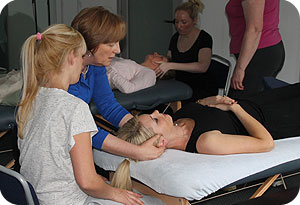
Back in October I presented a four days Level One Hendrickson Method Upper Extremities workshop with a wonderful group of therapists. I had the good fortune to be accompanied by a photographer, John Kirkbride, who documented the class. I think he has done a fabulous job of capturing the experience of being part of these workshops. It demonstrates a little example of what I want therapists to get from these workshops.

I endeavour in every one to create a warm atmosphere, where people feel relaxed and thereby in an environment where they feel comfortable to learn. Equally so, I really love it when I challenge therapists to explore new ways of thinking, and see them grow and flourish as therapists in their own right, incorporating what they learn into their practice. I also think it is essential to ensure we meet individual learning needs and requirements, and I am enjoying hearing how students that have been recording my classes with tablets or microphones for personal use are finding this a really helpful supporting tool to look back on with their clinics.

I hope you enjoy this little snapshot. If you think that this could be the right kind of environment for you, take a look at the workshops I have on offer for 2016 on my website.

Big hugs Sue

The three main problems with TMJ patients in clinic

I have a number of patients that come to me for TMJ, referred to me from several dental practices in my area. I find it Flexible-Healing-Training-in-Session-28interesting work, and have found that the people referred fall into three groups:
1.)    THE PROBLEM:
People suffering from osteoarthritis or dislocation of the temporomandibular joint. This group is relatively small in my experience.

THE FIX:
These people often need to be helped by the dental surgeon. We are able to help with the soft tissue, to keep the joint relaxed and as form of pain relief. However ultimately, once diagnosed, it is best to refer back the dentist.

2.)    THE PROBLEM:

Patients who have received dental treatment, and have as a result been sat in a dentist’s chair from anywhere between 1 to 3 hours, where they have been tense, fearful and holding tight the entire time. Staying so tense for such a period of time results in the body struggling to let go of the tension afterwards.

THE FIX:

In this case, lots of reassurance and explanation of what has happened is key. The muscular response is linked intrinsically to the emotional and neurological reaction of the event, and therefore we have to remind the muscles that they can relax. If we create soft tissue mobilisation that is pain free, the brain will establish that there is no longer a threat and cause the muscles to reset in a new relaxed state.

THE METHOD:
The best method I have found to achieve this is through Hendrickson Method soft tissue mobilisation. With the patient supine, I explain exactly what I am going to do, and then begin the treatment with anterior neck, paying special attention to scalenes, sternocleidomastoid and the hyoid group. I would then move on to the masseter, temporalis and digastric. I find once I have brought relaxation to the anterior, the posterior neck is ready to release.

3.)    THE PROBLEM:

People with busy or stressful lives, who often present with a forward head position or rounded shoulders, creating compression through C1 and C2. These people are often found with clenching jaw, but with no awareness that is occurring. With these people, it is as much about communication as it is the hands on approach.

THE FIX:
With these people a subjective and thorough initial assessment is crucial, where we can establish the root of the cause through examining lifestyle.

THE METHOD:
It is vital to first assess posture, exploring tight versus weak muscles to determine the muscular pattern they have adapted to manage the stress of their lives. I find commencing the treatment with a side lying wave mobilisation® works best, which helps to relax the patient. Address tight muscles first with soft tissue mobilisation and METs, explaining clearly each step. I then give the patient ‘homework’ which consists of a breathing routine using the abdomen, side and back ribs and sternum, which helps relaxation and acts as an exercise in body awareness.

I encounter these three problems, and variations on them, frequently, and the methods I have outlined above are consistently successful in helping the patient. The real key to treating TMJ however is seeing each patient as completely individual, and establishing a clear line of communication to understand their pain.

To find out more:

Treatment of TMJ Dysfunction & Pain – 1 Day


Muscle Energy Technique.

I find this technique really useful for lots of reasons, the major one for me, as Tom Hendrickson explains inFlexible-Healing-Training-in-Session-12.

‘Massage and Manual Therapy for Orthopedic Conditions’ ‘because MET uses voluntary effort, we are using the highest part of the central nervous system to re-program involuntary patterns in the muscles.’ I believe that when we can get our patients to engage at a conscious awareness that change can take place from pain free perspective, their confidence grows in their ability to recover.

It is super important that we enable/coach the patient create the ‘right ‘ or voluntary movement /contraction.

In some publications the movements to create the ‘resistance’ or contraction are quite big, creating either a pain, or a struggle, both ending up leaving the patient doubting the process, or causing the patient to guard against the action be that consciously or sub-consciously.

In training, seminars and publications we were told to hold the contraction for 5-10 seconds with 10 – 20% effort. Which I my experience works to a degree. Tom Hendrickson uses the cue ‘don’t let me move you’ which is extremely useful because you can decide/create the amount of resistance. This inspired me to use ‘just meet my hand’. What I have discovered with those patients in chronic pain, is to use ‘feather like’ resistance which creates the neurological (the sensory-motor process) process we are wanting that will bring about change with the soft tissue within the patients understanding of comfort.

In our practice, those patients who are finding it a bit of a challenge to create the movement that is being asked of them. We describe the movement, ask them to create that picture in their mind, remembering when it was pain free and easy. We find this coaching very successful along with gentle palpation to create a sensory cue

Also in my experience is that often the patients recruit a number of muscles to create a minor contraction i.e. piriformis. They will often bring in glut med, TFL, & IT band. Piriformis solo action is to create external rotation. I often coach my patients into making just a minor solo action with gentle fingers on piriformis acting as a gentle cue or encourage them to imagine the movement before they actually make the movement. I seem to be creating a more useful neurological connection which lengthens the fibres, warms the muscle up ready to move into Hendrickson Method® soft tissue mobilisation which eases the torsion through the fibres. I am finding patients returning to injury free movement much more swiftly with a deepening awareness of their own body and increasing confidence in their bodies can heal, leading to a more active lifestyle.

Would love to hear other practitioners experiences, as these are mine.